Monday, September 7, 2015
Labor Day Thoughts
Harold Meyerson for A Happy Labor Day
David Cay Johnston on why American Workers Deserve Better
The New York Times on Wages and Interest Rates
The President takes action on Paid Sick Leave while in Boston
John Lippitt on Investment in Human Capital
Friday, September 4, 2015
Show Me a Hero
Sunday, July 5, 2015
Greece and Democracy
As James Galbraith writes in The American Prospect and elsewhere ... The challenge in Europe is the narrowness of vision of the European elite. Centered in the governments of the core and bureaucracy of Brussels, these narrow minded leaders, not worthy of the word, have forced the continent into deflation and depression and threatened the whole European project. Achieving nothing but broader smiles in the face of David Cameron and the like who are bound and determined to blowup the entire structure.
All countries knew when they joined the EU they were sacrificing some sovereignty. The hope was the trade off resulted in more peace and more prosperity. And so it did as long as the bubble of trade deficits/debt/housing continued. When that popped the house of cards came tumbling down and with it the vision of Calvanistic punishment for incorrectly perceived profligacy. In the case of Greece, the price of relief from the commercial bankers was a regime imposed by The Troika. Today's vote is a chance for the Greek public to say No!
Yet their democratic choice has been complicated by the interference from the core. It is sadly funny to hear German politicians lecturing the Greeks about responsibility. The bottom line is that Greece should be free to make its choice and move ahead with its direction even if that means leaving the Euro Zone. Greece couldn't join Europe until it through off the shackles of dictatorship and moved to democracy. Why should Europe be demanding a step back when it benefitted from the policies that brought Greece to this point? Obviously leaders like Germany's Merkel are worried about the precedent of Syria in Greece leading to other anti-austerity tendencies like Podemos in Spain (who have elected Mayors in Madrid and Barcelona), the SNP in Scotland and the exciting emergence of Jeremy Corbyn as a candidate for Labour Party leadership in the UK. So they are saying let's rupture democratic processes so we can hang onto our jobs, continue the disastrous conventional wisdom and teach a harsh lesson in moral hazard.
Greece please, Just Vote No. #oxi
Wednesday, July 1, 2015
Good news from President Obama ... OT Edition
With the unemployment rate falling but the workforce participation rate and median wages still stagnant, the long steady recovery from the crisis of 2007 to 2009 has only begun to reach into the homes of working families. With the refusal of Congress to take aggressive action to promote job creation it falls to the President to use his executive authority to move forward a family friendly economic policy. Oddly enough the President pushed hard for fast-track approval to further the trade agenda with the pacific rim. Actions that will lessen the wages and employment prospects of American workers.
Important economic actions are outstanding ... the surface transportation bill has survived on short term renewals; the reauthorization of the Export-Import Bank languishes and we are about to go through another budget drama ... all of which contributes to economic instability at a time when the economy needs help to boost the fortunes of workers. The aggressive actions of the President will pay off with higher approval ratings. And with that perhaps he can drag Congress along in the right direction.
Monday, June 29, 2015
Greece, Democracy and the Way Forward
Prominent voices in the US and Europe have called for the people to vote "No". Some like Paul Krugman have warned for years that a single currency zone absent political integration would end in disaster. Joseph Stiglitz also counsels on his approach to the conflict and his rationale for the vote against the next wave of austerity. Two weeks ago Amartya Sen called on the EU to end its austerity regime aimed at Greece saying that the Keynesian formula of spending in the face of contraction (Greek GDP is down 25% since the crisis began four years ago) is the right one and austerity counterproductive. If three Noble Prize winning economists are saying the approach of the Troika are wrong ... who supports their destructive ideas?
As the great summary of the crisis from Social Europe shows, the point of the bailout of the government and the continued assistance to the Greek banks was to help the holders of Greek sovereign debt ... banks in Germany, France and the rest of Europe. Now the Troika largely owns the debt. So what the Troika wants Greece to do is contract the income of their people more in order to generate trade and government surpluses to provide funds to pay off the creditors. The fact of the matter is many of these institutions made poor business decisions and now the Greek people are asked to pay the bill. The Troika wants the Greek government to continue to commit Macro malpractice after a generation of Germany (and other export driven economies) allowing Greece to import significantly more than it exported in order to enrich Germany (and other export driven economies) which expanded the nation's indebtedness.
Today Greece has eliminated its current account deficit and so is near to running primary government surpluses. However, this level is not enough to repay the creditors. So what is to be done? The answer is to leave the Euro with all the risk and confusion that will entail. With its own currency Greece can devalue its debts. It is the path that allows Greece to control its future and have some hope of generating economic growth and prosperity. The question becomes to what lengths will Germany, and the other European powers-that-be, go to prevent Greece from charting its own future and self revaluing its debt?
Sunday, June 21, 2015
Testament of Youth (2014)
One hundred years ago the world was in the engulfed in the first of the three great European wars of the 20th Century. Starting in 1914 the First World War reached out of Europe to include Africa and North America in its insane grip. Millions died in the war and its indirect misery and the stage was set for the second and third (Cold) wars where the impact grew across the globe. In the U.S. The milestones seem to flow by with little note. The sad anniversary of the sinking of the ocean liner Lusitania was in May. Perhaps a wreath bobs on the ocean left by someone connected to the event.
Thankfully the British have taken one modest step to remind us of the origins and impacts of the war to end all war. Last fall a new feature length film version of the heart wrenching memoir, Testament of Youth was released theatrically in the UK. This weekend it finally made it to Boston. For those of us familiar with the work by the pacifist campaigner, Vera Brittain, the opening scenes of the idyll of the British countryside and the young people engaged in their last flirtation before the war fills one with dread. The film, as the book, pulls no punches in its depiction of the hubris of the British public thinking the war will be brief and impact less.
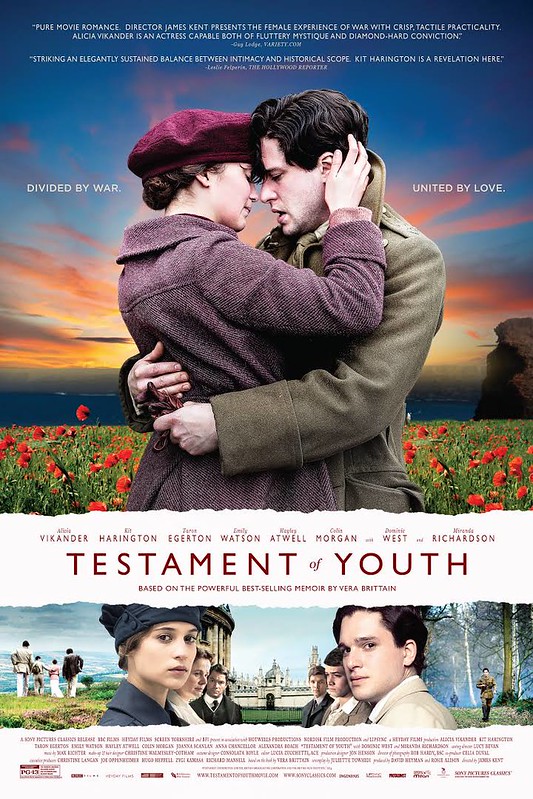
When I read that the filmmakers were redoing the story and eventually recast the lead to be Alicia Vikander I was a bit concerned. Could a young actress from Sweden capture the proper spirit of the strong headed woman who would make such a mark on generations to come? The 1933 book took on a renewed life in the late 1970's through an epic telling on the BBC with Cheryl Campbell as the lead. In the new film Vikander shows the talent that promises to make her a giant in international film. Given a spare script, she leaves no doubt on her angelic face of the range of emotions that young Vera experiences and she goes from rebellion to love to loss and then rebellion again.
She is paired with the equally beautiful Kit Harrington as her fiancé Roland Leighton. He, like her brother and their cohort of friends and school mates, march off to war with the care free bravado seen in other films of the era, Doctor Zhivago or Nicholas and Alexandra come to mind. They return in a way that killed that innocent Edwardian idyll and has left the world with a set of problems we have not transcended across the century. Vera loses all she cherishes on earth during the war but gains a self which the film allows us to glimpse. The text crawl at the end could not possibly do justice to the importance she had as a writer and graduate of Oxford who dedicated herself to trying to make the world a more peaceful place.
The story has haunted me for nearly forty years. Hopefully one hundreds years from now someone will write about how we have better learned the lessons she was trying to teach us. Not romance but practically that these foolish wars, which we still insist on fighting, makes us less safe and secure. And that their prosecution changes us and not for the better.
Friday, May 8, 2015
UK Election - Quick Thoughts
This time the protest vote went to the SNP in Scotland and the UK Independence Party in England. Ironically, UKIP which picked up hundreds of thousands of votes over 2010 and finished at 13% - got one seat in Parliament. The SNP which runs candidates only in Scotland, swept every district except three and won an additional 50 seats over 2010.
In a manner typical for British politics after a hard fought contest … heads are rolling as the leaders of Labour, LibDems and UKIP all resigned their posts. More on the travails of Labour and challenges for the next government soon.


