Monday, January 7, 2013

Interim Senator for Mass


Strange positioning occurring in Mass regarding the temporary appointment of a Senator to replace John Kerry once he is confirmed as Secretary of State. Congressman Barney Frank has indicated in recent days that he is available for the appointment which would bridge the period from Kerry's resignation (which hash't happened yet) and the special election which would be a few months later. Sources tell me that the front runner for the Governor's nod (its his appointment) is former Admin and Finance chief Jay Gonzalez. I am hearing from fellow Mass progressives that there is some momentum for Barney Frank and that the Globe will endorse the idea in the morning edition. Personally I think Barney Frank would be among the best qualified people in the country to fill the role (let alone Massachusetts). I can't imagine what political consultant Doug Rubin was thinking when he dissed the idea of a Frank appointment, but Rubin isn't  Congressional scholar so who cares.

Saturday, January 5, 2013

Early thoughts on ASSA 2013

Having been absent from the ASSA/AEA conference for a year I am concerned about the dying of the critical retrospection following the financial crisis of 2007. While there was significant discussion of the rupture of conventional wisdom during the Great Recession there is little continued examination in that vein. Too much of the discussion is about the deficit and debt and very little about unemployment. Some panels mention inequality but few solutions challenging the limits of narrow range of policy solutions.

Currently listening to the discussion at a panel on Media and Economics and the takeaway is that the important Econ journalism is through the scholar/bloggers like Paul Krugman, Brad deLong and Justin Wolfers. Christia Freeland accepts that idea ... Econ journalism needs to challenge the conventional.

More thoughts tomorrow from the plane.

Monday, December 24, 2012

Why Thomas Friedman is wrong again

In Sunday's NY Times columnist Tom Friedman has another column demonstrating how to contradict oneself within a paragraph or two and misunderstand markets and politics at the same time. He is bemoaning the descent into political madness of the large part of the Republican electorate that rejects any tax or gun control measures out of hand. The folks who believe that restrictions on automatic weapons are a giant threat to freedom but support massive government intervention into the health choices of women. He roles out reasonable objections to their positions such as objecting to a minor symbolic treaty for weirdly paranoid reasons. or not taking advantage of President Obama's ill considered offer to make senior citizens pay for tax cuts for families with comes over $250K.

But Friedman continues to make the same objectionable mistake in writing about politics that he always does...because he either knows little about electoral political history and public policy or chooses to ignore the evidence. He claims the Republicans need a DLC, an organized force to try to bring them to the corporatist middle. Ignoring the fact that the Democratic Party already fills that space and that when it followed his much praised pattern it did not achieve 50% of the vote in a presidential election even during the two Clinton victories. He claims there was some substantial split in the party because of "pragmatism" that resulted in Ralph Nader allowing GW Bush to win in 2000. How wrong could he be? The problem was the the fact that Nader could have a substantial impact on a poorly run election by getting so few votes. There was no split in the party as there was no substantial constituency from within the party that supported Nader in his candidacy. Most all Nader votes came from states that were not competitive.

That aside, Friedman continues on his desire to have two parties with no differences. It is a shame he does not think that the US is ready for democracy. He argues for "market based solutions" to public policy decisions but not to politics? The best way to get the Republicans to moderate their positions would be for people not to vote for them and for the "market" to reject their product. But what space is their for the "right-of-center" policy he seeks? Isn't the Democratic Party already the "right-of-center" offering? On most any policy issue the Democratic Party is to the right of the mainstream of thought in other advanced countries. Isn't the real opening for a more social democratic party in the US leaving the middle for the Republicans?

The challenge is lack of consensus in contemporary American politics. With a fight to the death to protect Social Security and Medicare the divide between the parties is substantial but we should not mistake that for left and right. Rather the center right and the hard right.

Wednesday, November 21, 2012

Europe (read Euro Zone) at it again

The "it" referred to in the headline is the ongoing European agony over the terms to extend further aid to Greece. The Germans are objecting to terms that may allow for official loses on sovereign loans. What is painful to watch is that in fact Germany has been a major facilitator of Greece's slide into crisis. In fact, the persistent trade deficit that Greece runs with Germany and the rest of the world is a significant cause of the problem. Since Greece must import manufactured goods and exports agricultural products (and tourism) it sends many Euros out of the country.

If Greece had their own currency then the balance of payments would require much if not all of the funds to return to the country as asset purchases. However, since Greece is paying its bills in Euros the funds can flow back into any Euro Zone country causing net flows out of the country. Not until the economy becomes exceedingly depressed will the Greek competitive advantage be significant enough to generate capital inflows. (Oh Greece lets invest there because they work so cheap.)

Germany benefitted from the weakening of the Greek position because it provided a market of higher income consumers for its products. And now they are threatening the spigot that provides Greece's lifeline. Even this article which tries to condemn Greek public finance choices (tax is too low, spending too high) they clearly show how Germany has benefitted from the situation in the past. Shouldn't they participate significantly in rectifying the imbalances?

Wednesday, July 25, 2012

UK Economy and Excuses

This would actually be funny except for the fact it is ruining millions of lives.


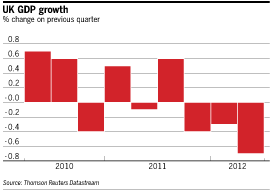
The UK announced second quarter GDP fell for the third quarter in a row. In fact the downturn is slowly increasing (-.4, -.3, -.7). In the middle of the article from FT.com describing the downturn is the following...


http://www.ft.com/cms/s/0/4d4586da-d634-11e1-ba60-00144feabdc0.html#ixzz21dmILKKM

"The output drop was exacerbated by the one-off effect of the Queen’s diamond jubilee bank holiday, which removed a working day from the quarter. The Office for National Statistics said it was too soon to try to quantify this distortive effect, but most economists had predicted it would knock about 0.5 percentage points from gross domestic product growth."


but here is the same set of excuses from the same period in a previous year...


Finally, the ONS believes that a whole range of one-off factors – including the extra bank holiday for the royal wedding and the disruption to industry's supply chains caused by the Japanese tsunami – depressed activity by around 0.5% in the three months to June. (The Guardian)


While there are certain types of economic output that would be lost due to holidays, it isn't a one time event if it happens every year. The cause of the downturn in the UK is the same austerity that is plaguing the continent.

Monday, July 2, 2012

SF FRB on fiscal policy

FRBSF Economic Letter: U.S. Fiscal Policy: Headwind or Tailwind? (2012-20, 7/2/2012) http://www.frbsf.org/publications/economics/letter/2012/el2012-20.html?utm_source=tw&utm_medium=social&utm_campaign=el20

Friday, June 1, 2012

David Cay Johnston on the bad economics of retail subsidies

How corporate socialism destroys | David Cay Johnston http://blogs.reuters.com/david-cay-johnston/2012/06/01/how-corporate-socialism-destroys/